

Opens November 2026
QA StepsLearn software testing by doing
QA Steps is a path of short courses where you test an online shop. Each lesson starts with a problem from the night shift at Shelf, teaches what you need to solve it, and ends with practice the platform checks for you.
It teaches the work of a manual software tester: test design, bug reports, APIs, databases, logs and mobile apps.
- courses
- 20
- lessons
- 329
- test questions
- 1,140
The QA Engineer Path: 13 courses
Take them in order, from your first bug report to testing a whole release. Each course is a different place at Shelf and ends with its own certificate.
 Course 1 · Night control roomSoftware Testing from Zero: The First ShiftExplain what testing can and cannot show, and write a bug report a developer can reproduce.8 lessons · Free
 Course 2 · Release boardHow Software Gets Built: Process for TestersPlace testing in a project, read a Scrum or Kanban board and choose what to retest.7 lessons
 Course 3 · Spec studioTest Design TechniquesFind gaps in a spec and derive test values with partitions, boundaries and decision tables.8 lessons
 Course 4 · Bug boardTest Cases, Bug Reports and Test PlansWrite test cases, track bugs in Jira, and plan and report a test cycle.13 lessons
 Course 5 · StorefrontWeb Testing with DevToolsTrace a request from the browser to the server and collect evidence in DevTools.13 lessons
 Course 6 · GatewayAPI Testing with PostmanSend, chain and check API requests, and report an API bug.12 lessons
 Course 7 · Data vaultDatabases and SQL for TestersCheck what the app saved, with SELECT, GROUP BY and JOIN.8 lessons
 Course 8 · Device wallMobile Testing and Traffic InterceptionPlan mobile checks, read app logs and change traffic through a proxy.12 lessons
 Course 9 · Engine roomCommand Line and Git for TestersFind errors in logs from the terminal and propose a change in Git.8 lessons
 Course 10 · Signal roomLogs, Metrics and Queues for TestersRead a dashboard, find a failing request in the logs and check a message queue.10 lessons
 Course 11 · Release conveyorEnvironments, Docker and CI for TestersStart the shop with Docker, run checks in CI and read an automated test report.9 lessons
 Course 12 · Model labAI Assistants for TestersUse an AI assistant on test work, catch what it gets wrong and decide what may go into it.5 lessons
 Course 13 · Night control roomRelease Night: Test a Shop End to EndPlan, test and report a release of the whole shop, and present it as a portfolio.10 lessons
After the API course: 5 protocol worlds
Each API protocol gets a course of its own, set in a world of old myths. You meet REST in Ancient Greece, GraphQL in Egypt, gRPC in China, WebSocket in Scandinavia and SOAP under the World Tree.
 Slavic folklore: the World TreeSOAP Testing in SoapUI and Postman: Tales of the World Tree20 lessons
 Ancient GreeceREST API Testing in Postman: Ancient Greece39 lessons
 Ancient EgyptGraphQL Testing with Postman: Scribes of the Duat31 lessons
 Ancient ChinaTesting gRPC with Postman: Myths of Ancient China31 lessons
 ScandinaviaWebSocket Testing in Postman: Myths of the North29 lessons
Two more: SQL and AI in testing
A working day of SQL against a real shop database. And how language models work, how to use an assistant on test tasks, and how to test a feature built on AI.


How you learn here
Short reading, then hands-on work. Everything below is built and waiting for the opening.
Lessons that start with a problem
Every lesson opens on a shift at Shelf, a made-up online shop. You get the problem first and the theory when you need it. Text and screenshots, no video.
Practice checked at once
Lessons end with tasks the platform checks on the spot: choices, matching, ordering, typed values and SQL queries. You see what is right and what to fix.
Your own sandboxes
The Shelf shop, its APIs and its logs run as real apps you test yourself, with bugs left in on purpose for you to find and report.
Tests and flashcards
Questions on the lessons with an explanation for each option, a timed mock exam, and flashcards that come back when you are about to forget them.
1,140 test questions
Drills and cheat sheets
Short drills on one skill, like boundary values, and one-page cheat sheets with definitions, diagrams and examples.
30 drills, 59 cheat sheets
Arti, the AI helper
Arti sits next to every task. Ask for a hint or an explanation and you get one, but never the answer itself.
Certificates
Finish a course and reach the pass mark to get a certificate with a page anyone can check. Finish the whole path for the path certificate.
Interview practice
A voice interview simulator asks the questions testers get in job interviews, scores each answer and shows what was missing.


QA Steps for iPhone and Android
The apps are coming too. Read a lesson on the bus, answer a task, review your flashcards, and carry on at the computer where you stopped.
Screens from the Android app in testing.
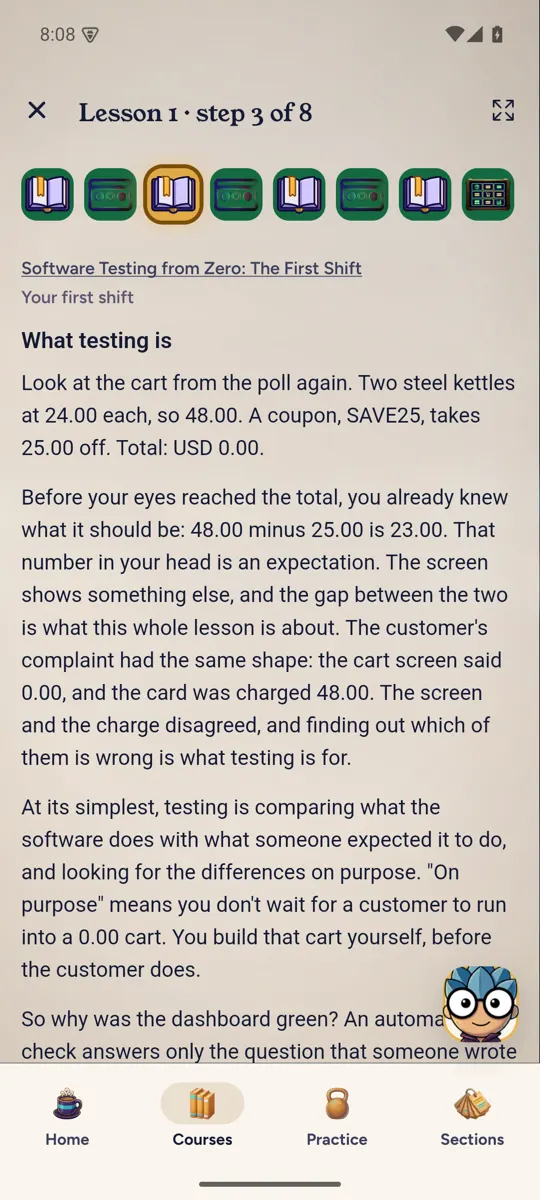
A lesson in the app 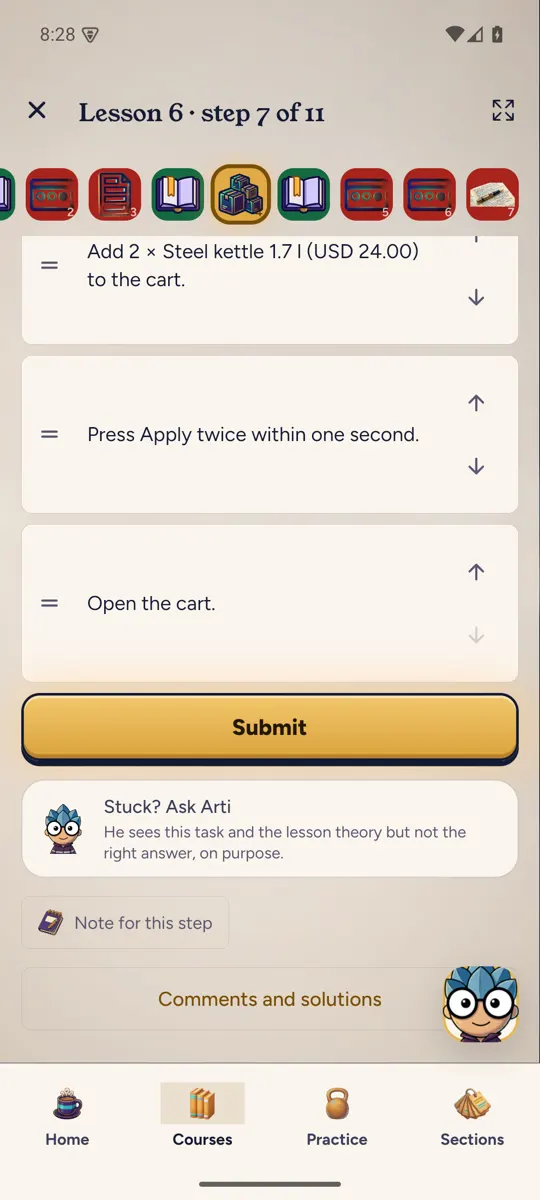
A task with Arti beside it 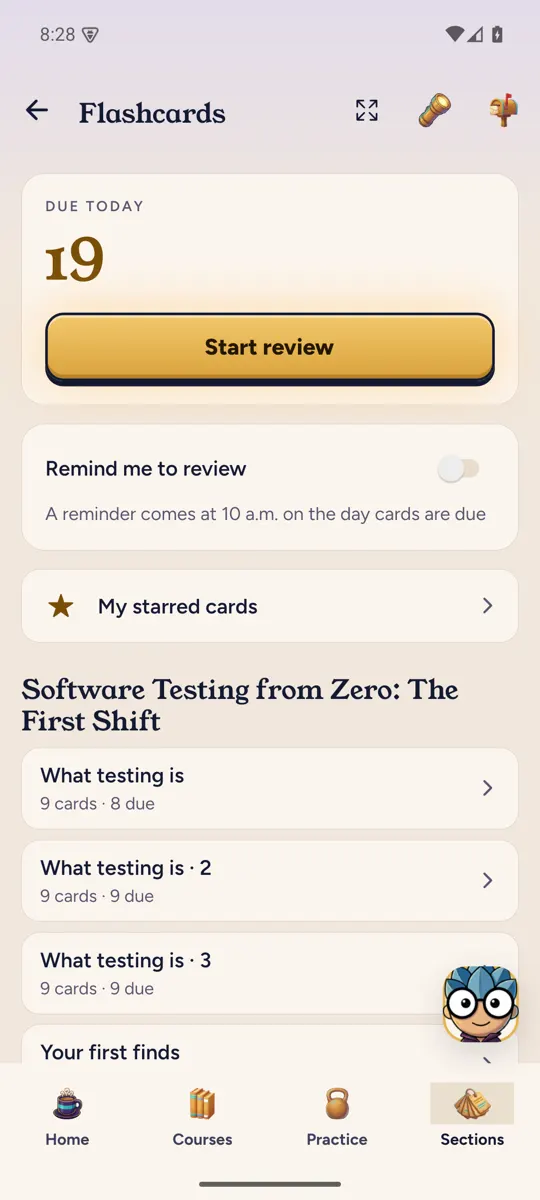
Flashcards due today
Prices at launch
Start free. Pay only if you want the whole path. Prices are in US dollars, shown yearly.
Free
Enough to find out if this is for you.
$0
- The whole first course
- The first two lessons of every other course
- Daily games, and tests on the lessons open to you
- A monthly allowance of questions to Arti
Plus
Everything you need to complete the path.
$99.99a year
or $14.99 a month
- Every course on the path
- A certificate of completion for each course
- AI review of your written practice, with a monthly limit
- More questions to Arti
Pro
For the parts that cost money to run.
$199.99a year
or $29.99 a month
- Everything in Plus
- A voice interview simulator
- Resume review
- The highest limits for Arti and practice review
Who teaches
Artsiom Rusau is a QA engineer. He has tested software since 2019 and has taught software testing since 2020. He wrote the courses and checks what they teach. He was on the program committee of the SQA Days testing conference in 2024 and 2025.
New to testing?
A plain answer to the first question most people have.
- Start hereHow to become a software testerWhat a software tester does, what to learn and in what order, and how to practice without a job: six steps from zero to a small portfolio.
- Bug reportsHow to write a bug reportThe fields of a bug report, a template to copy, a complete example from a practice shop, severity and priority with examples, and the mistakes that send a report back to you.
- Test casesHow to write test casesThe parts of a test case, a template, a complete example and its negative cases, the difference between a test case, a test scenario and a checklist, and how to fix a weak case.
- Test designBoundary value analysis and equivalence partitioning, with examplesHow to split inputs into equivalence partitions, pick boundary values with the 2-value and 3-value methods, and choose the step, worked through four fields of a practice shop.
Questions
What is QA Steps?
An online platform for learning software testing by doing. It is a path of 13 short courses in English. Each lesson is set at Shelf, a made-up online shop, and ends with practice the platform checks for you.
When does QA Steps open?
In November 2026. Join the waitlist on this page to get one email on the day it opens.
How much does it cost?
There is a free plan. Plus is $99.99 a year or $14.99 a month and opens every course. Pro is $199.99 a year or $29.99 a month and adds the features that cost money to run, such as the interview simulator.
Is it free?
Partly. The whole first course is free, and so are the first two lessons of every other course. You can find out if testing suits you before you pay anything.
Do I need experience or a technical background?
No. The first course starts from zero and assumes ordinary computer skills. It suits career changers and junior testers who want to fill gaps.
Which tools will I learn?
Browser DevTools, Postman, Jira, SQL in DBeaver, the command line and Git, Docker, Jenkins and GitHub Actions, Charles for mobile traffic, Grafana for logs and metrics, and SoapUI in the SOAP course. You use them on the Shelf shop and its sandboxes, not only read about them.
Is there a certificate?
Yes. Each course gives a certificate of completion once you reach its pass mark, with a page anyone can open to check it. Finishing all courses of the path gives the path certificate.
Is there a mobile app?
Yes, QA Steps for iPhone and Android is coming. Lessons, tasks and flashcards work in the app, and your progress is the same as on the website.
How is practice graded?
Most tasks are checked by the platform the moment you answer: choices, matching, ordering, typed values and SQL queries. In the sandboxes you find planted bugs and report them. Written work can also get an AI review, with a daily limit that depends on your plan.
What is Arti?
The AI helper of QA Steps. Arti gives hints and explains ideas next to each task, and it is built so that it does not hand you the answer.
Are there video lessons?
No. Lessons are text with screenshots of the real tools, so you read at your own speed and can find any step again in seconds.
Will this get me a job?
No course can promise that, and QA Steps does not. QA Steps gives you practice on the tasks testers do every day, interview practice, and a final course where you test a whole release and present it as a portfolio.
Opens November 2026
Hear when it opens
One email in November 2026, when QA Steps opens. Nothing else.